

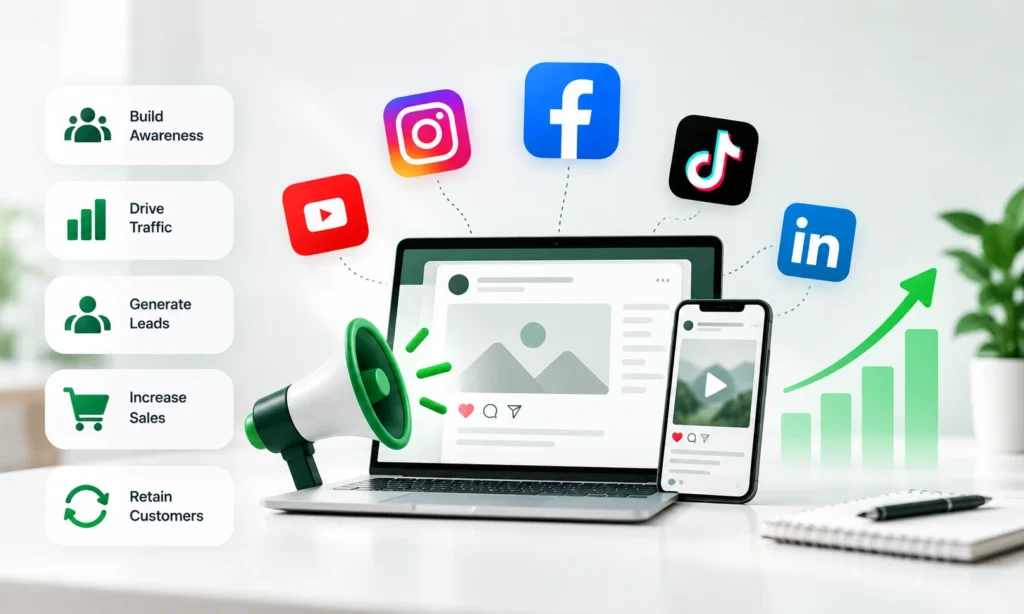
Social media marketing is the strategic use of social platforms to reach target customers, build brand awareness, create demand, generate leads, increase sales, and strengthen customer relationships. It combines content, community engagement, paid advertising, and performance measurement around specific business goals.
Simply having a Facebook page or posting on Instagram is not social media marketing.
Social media marketing is a planned business activity. It connects content, audience targeting, advertising, community management, and measurement to a specific outcome.
A local restaurant may use Facebook to increase reservations. An e-commerce brand may use Instagram and TikTok to generate product sales. A B2B company may use LinkedIn to reach decision-makers and generate qualified leads.
The platform changes. The content changes. The basic principle does not.
Successful social media marketing starts with the result the business wants to achieve.
What Is Social Media Marketing?
Social media marketing is the use of social media platforms to communicate with a target audience and achieve marketing goals such as brand awareness, website traffic, leads, sales, and customer retention.
It can include:
- Organic posts
- Short-form videos
- Educational content
- Community management
- Influencer partnerships
- Paid advertisements
- Retargeting campaigns
- Customer service
- Lead-generation campaigns
- Performance analysis
Social media marketing is therefore broader than publishing content.
A business might post three times per week and still have no real marketing system if those posts have no defined audience, goal, distribution plan, or measurement process.
A proper social media marketing strategy answers five basic questions:
- Who are we trying to reach?
- What do we want them to do?
- Which platforms can reach them?
- What content or offer will influence them?
- How will we measure whether it worked?
These questions turn social activity into marketing.
How Does Social Media Marketing Work?
Social media marketing works by connecting a business with the right audience through relevant content, organic distribution, paid promotion, engagement, and continuous performance optimization.
The process usually moves through seven stages.
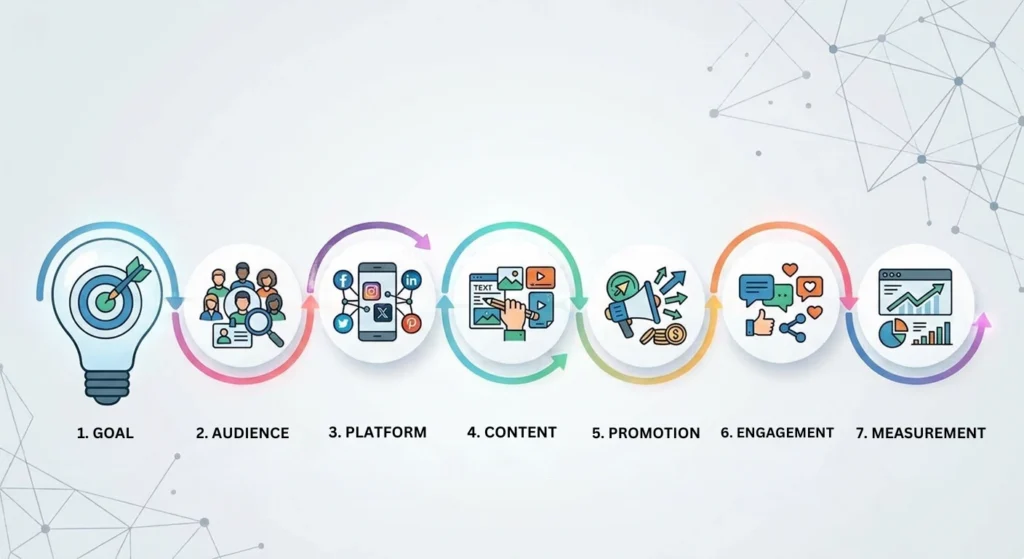
1. Define the Business Goal
The first step in social media marketing is defining the business outcome you want to achieve, such as increasing awareness, generating leads, booking appointments, or driving sales.
A goal such as “post every day” describes an activity. It does not explain what the business expects to gain.
Better goals include:
- Increase brand awareness in a target market
- Generate qualified inquiries
- Increase website sales
- Book appointments
- Promote a new product
- Reduce customer acquisition cost
- Increase repeat purchases
- Build a community around the brand
- Retarget previous website visitors
The goal determines almost everything that follows.
A company trying to generate leads may prioritize educational content, case studies, lead forms, landing pages, and retargeting.
A company trying to increase awareness may focus more on reach, video views, creator partnerships, and shareable content.
2. Identify the Target Audience
A target audience is the specific group of people a business wants to reach based on factors such as location, interests, needs, job role, behavior, and buying intent.
A useful audience profile can include:
- Age range
- Location
- Occupation
- Income level
- Interests
- Problems
- Buying motivations
- Common objections
- Preferred content formats
- Platforms used
- People involved in the buying decision
A B2B software company, for example, may need to reach operations managers rather than a general business audience.
A fashion e-commerce business may target several customer groups based on age, style preference, price sensitivity, or product category.
Better audience understanding leads to better content, targeting, offers, and conversion rates.
3. Choose the Right Social Platforms
The right social media platform is the one where a business can reliably reach its target audience using content that fits both the platform and the customer’s buying behavior.
Businesses do not need to be active everywhere.
For example:
- Facebook can work well for consumer audiences, local businesses, communities, and remarketing.
- Instagram suits visual brands, fashion, beauty, food, lifestyle, and e-commerce.
- TikTok supports discovery, short-form video, product demonstrations, and creator-led marketing.
- LinkedIn is particularly useful for B2B businesses and professional audiences.
- YouTube works well for education, tutorials, reviews, demonstrations, and deeper product research.
A company should usually build a strong system on a few relevant platforms before expanding.

4. Create Relevant Content
Relevant social media content addresses the audience’s interests, questions, problems, or buying concerns while connecting those topics to the business’s products, services, or expertise.
Content can include:
- Educational posts
- Product demonstrations
- Customer stories
- Case studies
- Tutorials
- Short videos
- Behind-the-scenes content
- Industry commentary
- FAQs
- Comparisons
- Testimonials
- Offers
- Live videos
- User-generated content
Good content does not always need expensive production.
It needs to be useful, clear, relevant, and appropriate for the platform.
A roofing contractor, for example, could explain signs of roof damage rather than repeatedly posting “Call us for roofing services.”
The educational content earns attention by solving a problem. The service becomes the natural next step.
5. Distribute and Promote Content
Social media content distribution is the process of getting content in front of more relevant people through organic reach, paid advertising, partnerships, communities, retargeting, and cross-platform promotion.
Creating good content does not guarantee that enough people will see it.
Businesses can distribute content through:
- Organic feeds
- Paid advertising
- Employee sharing
- Community groups
- Influencer partnerships
- Retargeting
- Email newsletters
- Cross-platform promotion
- Collaborations
A strong piece of content can also be repurposed.
A detailed YouTube video could become:
- Three short videos
- A LinkedIn post
- An Instagram carousel
- Several Facebook posts
- An email
- A retargeting ad
This increases the value of the original idea without requiring new content from scratch every day.
6. Engage With the Audience
Social media engagement means responding to and interacting with people through comments, messages, reviews, mentions, questions, and community discussions.
Social media is not a one-way publishing channel.
People can:
- Comment
- Ask questions
- Send direct messages
- Share posts
- Mention the business
- Leave reviews
- Discuss products
- Raise complaints
Businesses should treat these interactions as part of marketing.
A useful answer to a product question can move a potential customer closer to buying.
A thoughtful response to a complaint can protect trust.
Comments and messages can also reveal what customers want, misunderstand, or worry about.
7. Measure and Optimize Results
Measuring social media marketing means tracking performance against business goals and using the results to improve content, targeting, advertising, and conversion performance.
If the goal is lead generation, useful metrics may include:
- Leads generated
- Cost per lead
- Qualified lead rate
- Appointment rate
- Sales conversion rate
- Revenue
If the goal is awareness, useful metrics may include:
- Reach
- Impressions
- Video views
- Brand searches
- Profile visits
- Engagement
The business can then identify which audiences, platforms, messages, and campaigns deserve more investment.
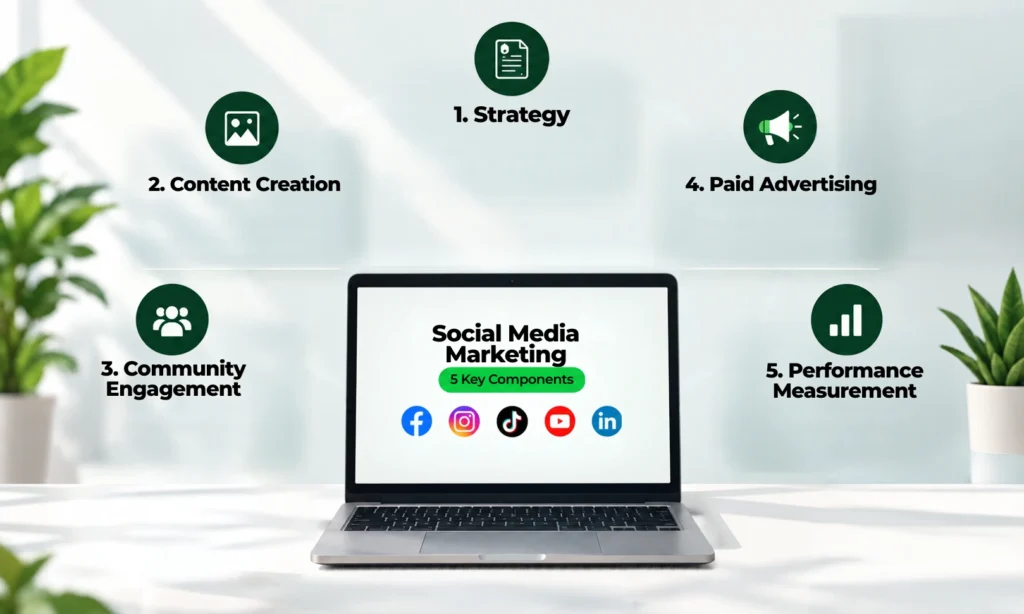
What Are the Main Components of Social Media Marketing?
The five main components of social media marketing are strategy, content creation, community engagement, paid advertising, and performance measurement.
These components work together rather than operating as separate activities.
Social Media Strategy
A social media strategy defines who a business wants to reach, what it wants to achieve, which platforms it will use, what it will communicate, and how success will be measured.
A strategy typically defines:
- Goals
- Target audiences
- Platforms
- Positioning
- Content themes
- Offers
- Publishing approach
- Paid advertising
- Measurement
Without strategy, businesses often fall into random posting.
They publish because they feel they should remain active rather than because the activity supports a specific outcome.
Content Marketing
Social media content marketing uses useful, relevant, or persuasive content to attract attention, educate potential customers, build trust, and support buying decisions.
A strong content mix might include:
- Educational content
- Trust-building content
- Product or service content
- Customer proof
- Brand content
- Conversion-focused offers
Different content serves different stages of the customer journey.
Not every post should try to make an immediate sale.
Community Engagement
Community engagement is the ongoing interaction between a business and its social media audience through comments, messages, reviews, mentions, conversations, and customer support.
This includes:
- Replying to comments
- Answering direct messages
- Joining relevant conversations
- Managing reviews
- Responding to mentions
- Encouraging user-generated content
- Supporting existing customers
Community management becomes especially important when customers ask questions before making a purchase.
Paid Social Media Advertising
Paid social media advertising allows businesses to pay platforms such as Facebook, Instagram, LinkedIn, TikTok, and YouTube to show content or ads to selected audiences.
Paid campaigns can support:
- Awareness
- Video views
- Website traffic
- Lead generation
- App installs
- Product sales
- Retargeting
- Local promotion
Paid advertising provides more control over distribution than organic publishing alone.
However, advertising works best when the business already has a strong offer, good creative, relevant targeting, and an effective conversion process.
Performance Measurement
Social media performance measurement evaluates whether marketing activity produces the intended business results using metrics such as reach, leads, conversion rate, customer acquisition cost, revenue, and return on ad spend.
The goal is not simply to produce reports.
Measurement should help determine what to:
- Increase
- Improve
- Test
- Reduce
- Stop
One campaign may generate cheaper leads while another generates more profitable customers.
Looking only at cost per lead could therefore produce the wrong decision.
Businesses should connect social media data with sales and revenue whenever possible.
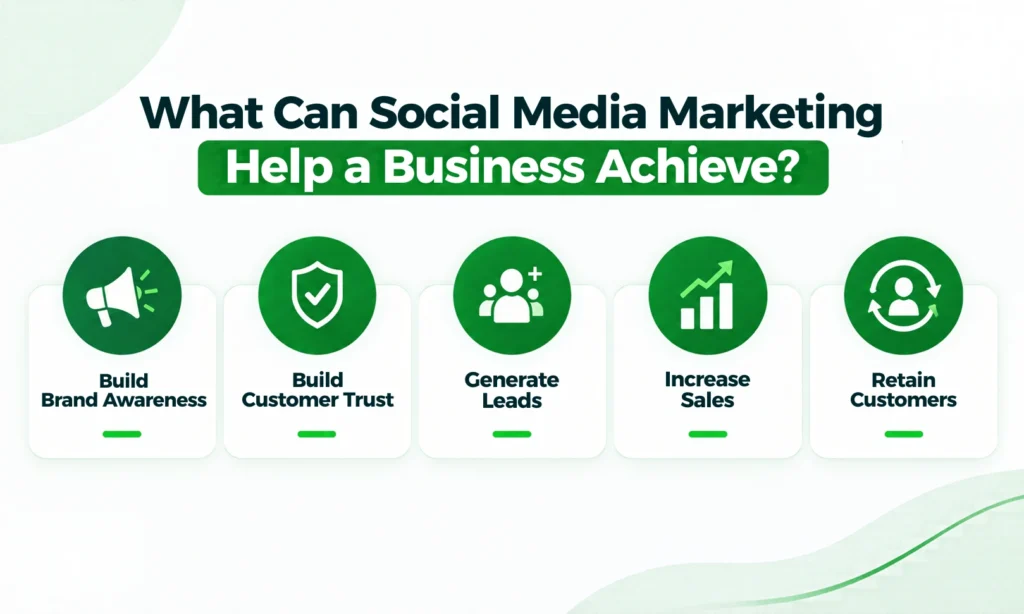
What Can Social Media Marketing Help a Business Achieve?
Social media marketing can help businesses increase brand awareness, build trust, generate leads, drive sales, retain customers, and strengthen relationships with their target market.
The specific result depends on the strategy, platform, audience, offer, and measurement system.
Build Brand Awareness
Social media builds brand awareness by repeatedly exposing target audiences to a company’s name, message, products, expertise, and visual identity.
People are more likely to consider brands they already recognize.
Repeated exposure to useful or memorable content can make a company more familiar within its target market.
This can be particularly valuable for businesses entering a new market or competing with established brands.
Build Customer Trust
Social media helps build customer trust by showing real expertise, customer experiences, business activity, product quality, transparency, and social proof.
Potential customers may check a company’s social profiles before contacting or buying from it.
They may look for:
- Recent activity
- Customer comments
- Reviews
- Product demonstrations
- Staff
- Previous projects
- Educational content
- Customer experiences
A credible social presence can reduce uncertainty.
For service businesses, case studies and customer results can be especially persuasive.
Generate Leads
Social media lead generation is the process of turning social media users into potential customers through inquiries, forms, messages, calls, bookings, or website actions.
A lead may come from:
- A direct message
- A lead-generation form
- A website form
- A phone call
- A WhatsApp conversation
- An appointment booking
- A webinar registration
Lead quality matters more than total lead volume.
A campaign producing 20 qualified prospects may be more valuable than one producing 100 irrelevant inquiries.
Increase Sales
Social media can increase sales by helping customers discover products, evaluate options, see social proof, respond to promotions, and return through retargeting campaigns.
Social media can support sales through:
- Product discovery
- Promotional campaigns
- Retargeting
- Reviews
- User-generated content
- Product demonstrations
- Creator partnerships
- Direct-response advertising
However, social media rarely controls the entire buying process.
Pricing, shipping, website quality, product quality, customer support, and sales follow-up also influence revenue.
Retain Existing Customers
Social media helps retain customers by keeping the brand connected with buyers after the first purchase through support, education, updates, communities, and loyalty-focused content.
Retention content can include:
- Product education
- New product announcements
- Customer communities
- Support
- Loyalty promotions
- Helpful tips
- Exclusive offers
Satisfied customers can also become brand advocates and recommend the business to others.
Organic vs Paid Social Media Marketing
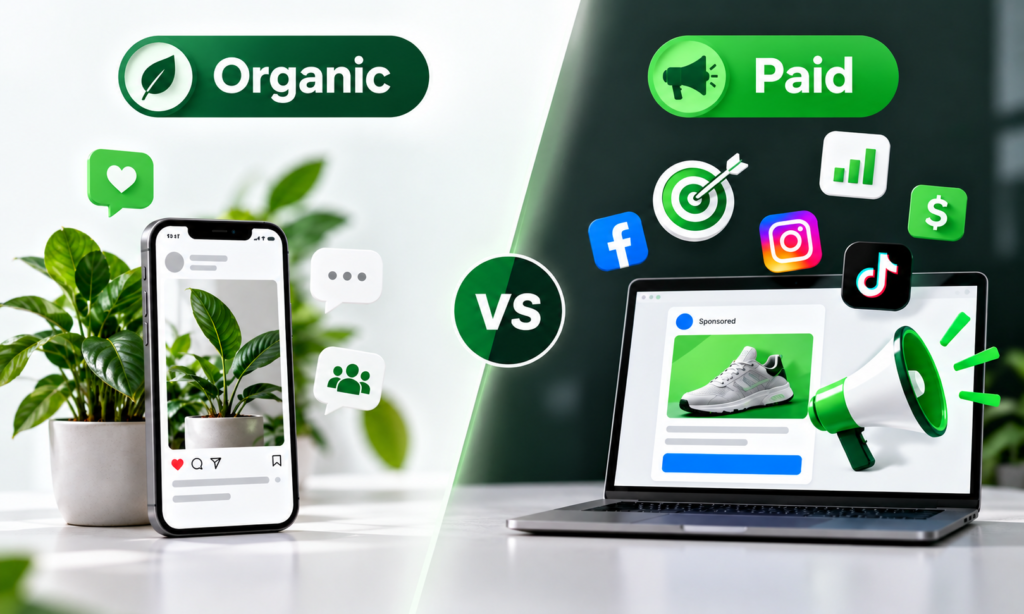
Organic social media uses unpaid content and engagement to reach audiences, while paid social media uses advertising budgets to buy targeted distribution and reach specific users.
Both approaches can play important roles within the same marketing strategy.
What Is Organic Social Media Marketing?
Organic social media marketing is unpaid activity such as regular posts, videos, stories, comments, community management, and conversations used to build relationships and brand visibility.
Examples include:
- Publishing posts
- Sharing videos
- Replying to comments
- Posting stories
- Managing communities
- Publishing educational content
- Joining industry conversations
Organic marketing helps businesses build credibility, understand audiences, maintain customer relationships, and develop a long-term brand presence.
Its main limitation is distribution.
Even strong content may not consistently reach enough potential customers organically.
What Is Paid Social Media Marketing?
Paid social media marketing is the use of advertising budgets to promote content, products, services, or offers to targeted audiences on social platforms.
Businesses may target audiences based on factors such as:
- Location
- Interests
- Demographics
- Job roles
- Previous website visits
- Customer lists
- Previous engagement
Paid advertising provides greater control over reach and audience selection.
It can also produce results faster than waiting for organic growth.
However, paid advertising does not fix a weak business offer.
Increasing ad spend on a poor offer can simply increase losses.
How Organic and Paid Social Work Together
Organic and paid social media work together when organic content builds trust and identifies strong messages while paid advertising expands reach, accelerates acquisition, and retargets interested audiences.
Organic content can reveal:
- Topics people care about
- Creative formats that attract attention
- Common questions
- Customer objections
- Strong messages
High-performing organic content can then be promoted through paid campaigns.
Paid advertising can also bring new people into the brand’s ecosystem, where organic content continues building trust.
For example:
Paid ad → Website visit → Retargeting → Social proof → Purchase
How Social Media Marketing Fits Into the Customer Journey
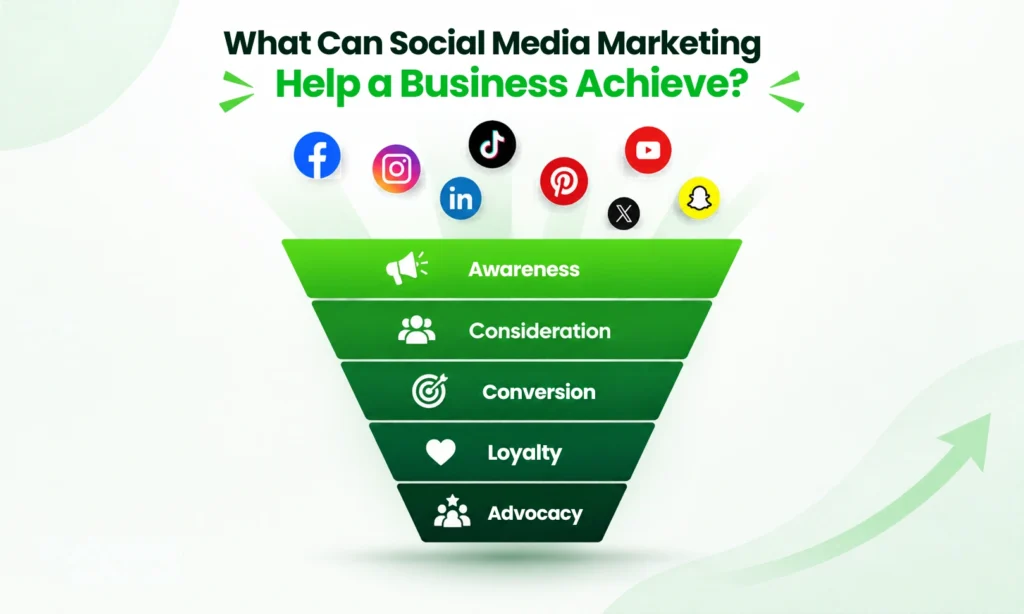
Social media can influence every stage of the customer journey, from initial awareness and consideration to conversion and long-term customer retention.
Different content and campaigns should be used at different stages.
Awareness
At the awareness stage, social media introduces potential customers to a problem, solution, product, service, or brand for the first time.
Useful content includes:
- Educational videos
- Problem-focused posts
- Industry insights
- Entertaining content
- Creator content
The primary goal is usually attention rather than immediate conversion.
Consideration
At the consideration stage, customers compare solutions, research brands, evaluate alternatives, and look for evidence that a product or service fits their needs.
Useful content includes:
- Comparisons
- Case studies
- Product demonstrations
- Testimonials
- FAQs
- Reviews
- Detailed educational content
The customer is essentially asking:
“Is this the right option for me?”
Conversion
At the conversion stage, social media encourages an interested prospect to take a measurable action such as purchasing, booking, calling, requesting a quote, or submitting a lead form.
Useful content and campaigns may include:
- Offers
- Free consultations
- Product ads
- Retargeting
- Free trials
- Lead forms
- Booking links
- Customer proof
Reducing friction becomes especially important at this stage.
The customer should clearly understand what to do next.
Retention
At the retention stage, social media helps businesses stay connected with existing customers and encourage repeat purchases, loyalty, referrals, and long-term relationships.
Useful content includes:
- Support information
- Product tips
- Updates
- Loyalty programs
- Community content
- New product announcements
Retention is especially important for businesses that depend on repeat purchases or recurring revenue.
Social Media Marketing Examples for Different Businesses
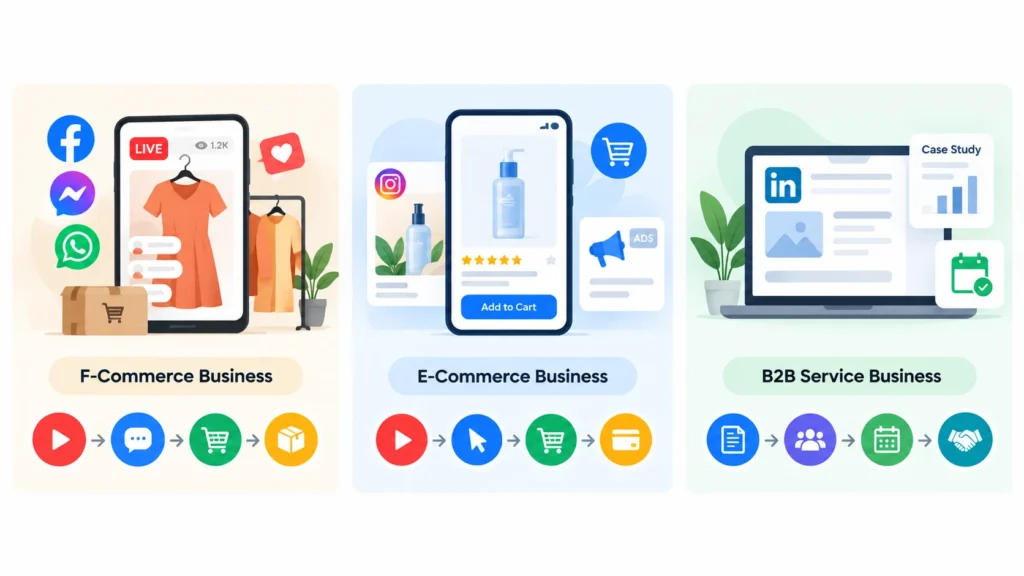
Social media marketing strategies vary by business model because an F-commerce seller, e-commerce store, and B2B service company have different customers, platforms, conversion paths, and buying cycles.
The strategy should reflect how each business actually earns revenue.
F-Commerce Business
An F-commerce business can use Facebook content, live video, Messenger, WhatsApp, reviews, and paid ads to move customers from product discovery directly into conversations and orders.
A clothing seller might use:
- Facebook posts for new products
- Short videos to show fabric and fit
- Facebook Live for launches
- Messenger or WhatsApp for orders
- Customer reviews for trust
- Retargeting ads for previous viewers
The conversion path could be:
Facebook video → Product inquiry → Messenger conversation → Order
For this type of business, customer response speed can strongly affect sales.
E-Commerce Business
An e-commerce business can use social media to attract shoppers, send them to product pages, retarget non-buyers, provide social proof, and generate online purchases.
A skincare brand could publish:
- Product tutorials
- Before-and-after demonstrations
- Customer reviews
- Ingredient education
- Creator videos
- Product comparisons
Paid campaigns could retarget people who:
- Viewed products
- Added products to cart
- Watched videos
- Visited the website
- Purchased previously
The customer journey could look like:
Short video → Product page → Retargeting → Customer review → Purchase
B2B Service Business
A B2B service business can use social media to demonstrate expertise, reach decision-makers, build credibility, generate qualified leads, and support longer sales cycles.
A software development agency could use LinkedIn to publish:
- Project case studies
- Industry insights
- Problem-solving content
- Technical explanations
- Client results
- Founder expertise
Instead of asking users to buy immediately, the company may encourage:
- Consultation bookings
- Audit requests
- Demo requests
- Downloads
- Email subscriptions
The journey might look like:
LinkedIn post → Case study → Website visit → Consultation → Proposal
Which Social Media Platforms Can Businesses Use?
Businesses can use Facebook, Instagram, TikTok, LinkedIn, YouTube, and other social platforms depending on their target audience, business model, content format, and marketing goals.
There is no single best platform for every company.
Facebook is useful for businesses that want to reach broad consumer audiences, local customers, communities, existing customers, and retargeting audiences.
Facebook can support:
- Local businesses
- Consumer brands
- Communities
- Events
- Lead generation
- E-commerce
- Retargeting
- Customer communication
Facebook Groups can also help businesses build communities around shared interests.
Instagram is a visual social media platform well suited to brands in industries such as fashion, food, beauty, fitness, travel, lifestyle, design, and e-commerce.
Common formats include:
- Reels
- Stories
- Carousels
- Photos
- Live video
Strong visual presentation matters, but usefulness and clear messaging remain essential.
TikTok
TikTok is a short-form video platform that businesses can use for product discovery, education, entertainment, demonstrations, trends, and creator-led marketing.
Businesses can use it for:
- Product demonstrations
- Educational clips
- Trends
- Creator collaborations
- Behind-the-scenes content
- Entertainment
- Customer stories
Content that feels natural to the platform often works better than highly polished corporate advertising.
LinkedIn is particularly useful for B2B marketing because businesses can reach professionals, executives, decision-makers, recruiters, and industry specialists.
Effective LinkedIn content often includes:
- Industry analysis
- Case studies
- Research
- Practical advice
- Company insights
- Professional opinions
For many B2B businesses, authority and expertise are more important than entertainment.
YouTube
YouTube helps businesses reach customers through searchable video content, tutorials, demonstrations, comparisons, reviews, case studies, and long-form educational material.
Businesses can create:
- Tutorials
- Product reviews
- Comparisons
- Interviews
- Demonstrations
- Case studies
- Explainer videos
- Webinars
YouTube can be especially useful when customers need significant information before buying.
What Metrics Should a Business Track?
Businesses should track social media metrics that match their goals, including reach, engagement, website traffic, leads, conversion rate, customer acquisition cost, revenue, and return on ad spend.
No single social media metric tells the entire story.
Reach and Engagement Metrics
Reach and engagement metrics show how many people see social content and how actively they interact with it through views, likes, comments, shares, saves, and profile visits.
Common metrics include:
- Reach
- Impressions
- Video views
- Watch time
- Likes
- Comments
- Shares
- Saves
- Profile visits
- Follower growth
These numbers show whether people notice and interact with the content.
They do not automatically prove that the marketing is profitable.
Lead and Conversion Metrics
Lead and conversion metrics measure how effectively social media turns attention into business actions such as inquiries, appointments, purchases, and qualified opportunities.
Businesses can track:
- Website visits
- Leads
- Cost per lead
- Qualified leads
- Conversion rate
- Appointment bookings
- Purchases
- Cost per acquisition
Lead quality should also be evaluated.
Ten qualified leads can be more valuable than 100 poor-quality inquiries.
Customer Acquisition Cost and Revenue
Customer acquisition cost and revenue metrics show whether social media is producing customers and financial returns at a sustainable cost.
One important metric is Customer Acquisition Cost, or CAC.
A simple calculation is:
Marketing and sales acquisition costs ÷ New customers acquired = CAC
Another useful measure is Return on Ad Spend, or ROAS.
Revenue attributed to advertising ÷ Advertising spend = ROAS
For example, $10,000 in attributed revenue from $2,500 in advertising spend produces a 4x ROAS.
Businesses should also consider profit margins.
High revenue does not necessarily mean a campaign is profitable.
Common Social Media Marketing Mistakes
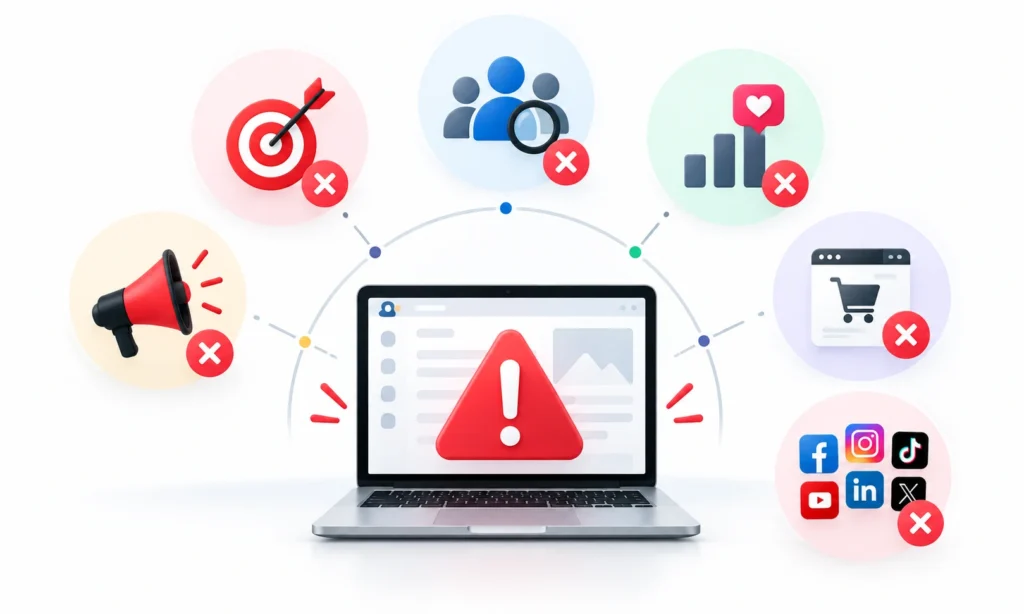
Common social media marketing mistakes include posting without goals, choosing the wrong platforms, focusing on vanity metrics, being overly promotional, running ads into weak conversion systems, and trying to manage too many channels.
These mistakes usually occur when activity is disconnected from business strategy.
Posting Without a Business Goal
Posting without a business goal makes it difficult to determine whether social media activity is helping the company generate awareness, leads, sales, or customer retention.
Every content category should have a purpose.
A post might aim to:
- Reach new people
- Build trust
- Answer objections
- Generate inquiries
- Drive website traffic
- Support retention
Without clear objectives, businesses can remain active for months without knowing whether their work is producing value.
Choosing Platforms Without Understanding the Audience
Businesses should choose social platforms based on where their target customers spend time and make decisions, not simply on which platform is most popular.
The better question is not:
“Which platform has the most users?”
It is:
“Where can we efficiently reach people who are likely to become customers?”
Focusing Only on Followers and Likes
Followers and likes are useful engagement signals, but they do not directly show whether social media is generating qualified leads, customers, revenue, or profit.
A smaller audience that produces customers can be more valuable than a large audience that rarely purchases.
Businesses should track metrics closer to actual business outcomes.
Making Every Post Promotional
Making every social media post promotional can reduce audience interest because people generally need useful information, trust, and relevance before responding to sales messages.
A healthier content mix combines:
- Education
- Entertainment
- Trust
- Proof
- Brand personality
- Promotion
Promotional content becomes stronger when the audience already understands and trusts the business.
Running Ads Without Fixing Conversion Problems
Paid social ads cannot compensate for major conversion problems such as a weak offer, poor landing page, slow website, unclear pricing, difficult checkout, or poor sales follow-up.
Common problems include:
- Confusing offers
- Slow websites
- Poor landing pages
- Weak product pages
- Unclear value
- Slow responses
- Complicated checkout
- Poor follow-up
Before increasing advertising spend, identify where potential customers are dropping out.
Trying to Manage Too Many Platforms
Managing too many social platforms can reduce content quality and consistency because every platform requires creative production, engagement, publishing, reporting, and optimization.
Being average on six platforms is not necessarily better than being strong on two.
Start where the best audience and commercial opportunity exist.
Expand only when the existing system is working.
How to Build a Simple Social Media Marketing System
A simple social media marketing system starts with a clear goal, defined customer, suitable platform, repeatable content pillars, customer-journey content, paid distribution when needed, and regular performance review.
Businesses do not need a complicated strategy to begin.
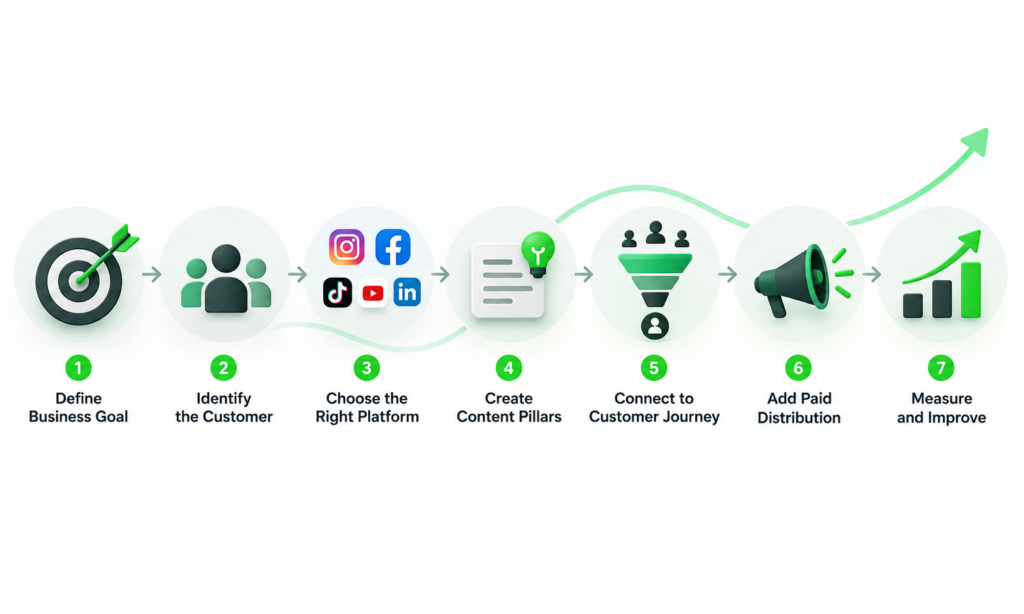
Step 1: Define the Business Goal
Start by choosing the specific business result social media should support, such as qualified leads, sales, appointments, awareness, or repeat purchases.
Examples include:
- Generate 50 qualified leads per month
- Increase online sales
- Build awareness in a new city
- Increase repeat purchases
Avoid vague goals such as “grow social media.”
Step 2: Identify the Customer
Identify the customer by defining who they are, what they need, what problems they face, why they buy, what prevents them from buying, and where they spend time online.
Write down:
- Who the customer is
- What problem they have
- What they care about
- Why they buy
- Why they hesitate
- Where they spend time online
This information becomes the foundation for content, offers, and targeting.
Step 3: Choose the Right Platform
Choose the social platform where your target customer is active and where your business can consistently create content that supports the buying process.
A B2B consultant may prioritize LinkedIn.
A fashion retailer may focus on Instagram, Facebook, and TikTok.
A technical equipment business may benefit heavily from YouTube.
Platform selection should follow audience behavior.
Step 4: Create Content Pillars
Content pillars are recurring topic categories that help a business consistently create relevant social media content around customer needs and company expertise.
A digital marketing agency might use:
- Marketing education
- Case studies
- Industry insights
- Common mistakes
- Service explanations
Content pillars make planning easier without forcing the business to invent unrelated ideas every day.
Step 5: Connect Content to the Customer Journey
Connecting content to the customer journey means creating different content for people who are discovering the brand, evaluating it, preparing to buy, and already using its products or services.
For example:
Awareness: Educational posts, short videos, industry insights.
Consideration: Case studies, testimonials, comparisons, guides.
Conversion: Offers, consultations, demonstrations, free trials.
Retention: Support, updates, customer education, loyalty content.
This creates a clearer path from attention to revenue.
Step 6: Add Paid Distribution When Appropriate
Paid distribution should be added when a business has a clear offer, proven messaging, suitable creative, reliable tracking, and a conversion process capable of handling additional traffic.
Before scaling paid advertising, the business should ideally have:
- A clear offer
- Useful content
- A good landing page
- Reliable sales follow-up
- Conversion tracking
Paid media then becomes a way to accelerate a functioning system rather than compensate for a weak one.
Step 7: Measure and Improve
Regular measurement helps businesses identify which content, audiences, platforms, and campaigns produce the strongest business results and where resources should be reallocated.
Ask:
- Which content produces qualified engagement?
- Which platform generates the best customers?
- Which ads lead to revenue?
- Where do potential customers drop out?
- Which messages perform best?
- What should we stop doing?
Use the answers to improve the next marketing cycle.
When Social Media Marketing Is Not the Main Problem
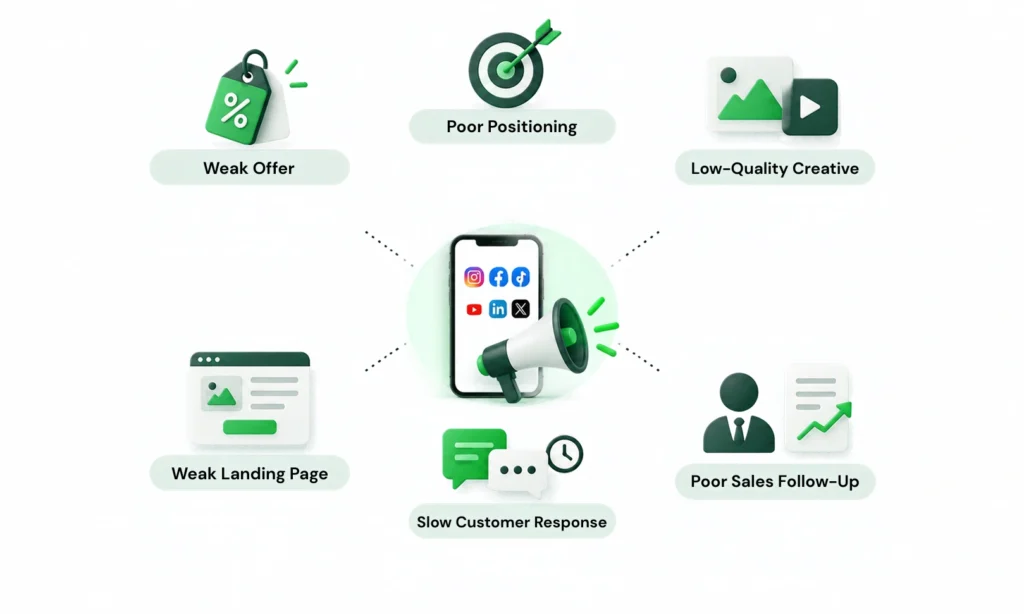
Social media may not be the main problem when poor results are caused by a weak offer, unclear positioning, low-quality creative, poor landing pages, slow responses, or ineffective sales follow-up.
Increasing content output or ad spend will not automatically fix these issues.
Weak Offer
A weak offer makes social media marketing harder because customers do not see enough value, differentiation, urgency, or reason to choose the business.
A weak offer may have:
- No obvious value
- Poor pricing
- No differentiation
- High perceived risk
- Unclear benefits
Marketing can attract attention, but the offer still has to convert that attention into action.
Poor Positioning
Poor positioning makes it difficult for potential customers to understand what a business does, who it serves, how it differs from competitors, and why that difference matters.
Customers should quickly understand:
- What the company does
- Who it serves
- What makes it different
- Why that difference matters
If positioning is unclear, social media messaging usually becomes unclear as well.
Low-Quality Creative
Low-quality social media creative fails to capture attention or communicate value clearly, reducing the performance of both organic content and paid advertising.
Problems may include:
- Weak opening
- Poor visuals
- Unreadable text
- Generic stock imagery
- Long introductions
- No clear message
- Content that immediately feels like an advertisement
Better creative can improve performance even when targeting remains unchanged.
Weak Landing Page
A weak landing page reduces social media performance when visitors click an ad or post but cannot quickly understand the offer, trust the business, or complete the intended action.
Check:
- Loading speed
- Headline
- Offer
- Trust signals
- Reviews
- Product information
- Call to action
- Mobile usability
- Forms
- Checkout process
The marketing channel cannot permanently compensate for a poor destination.
Slow Customer Response
Slow customer response can reduce social media lead conversion because prospects often contact several businesses and may choose the company that responds first and answers their questions clearly.
This matters particularly when customers use:
- Messenger
- Direct messages
- Lead forms
- Phone calls
A good lead can be lost after marketing has done its job.
Poor Sales Follow-Up
Poor sales follow-up causes qualified social media leads to go unconverted when businesses fail to respond consistently, send proposals quickly, track opportunities, or continue communication.
Common problems include:
- Missed calls
- One-time follow-ups
- Late quotes
- Poor lead tracking
- Weak sales conversations
- No follow-up after proposals
Marketing generates opportunities.
Sales has to convert them.
Social Media Presence vs Social Media Marketing
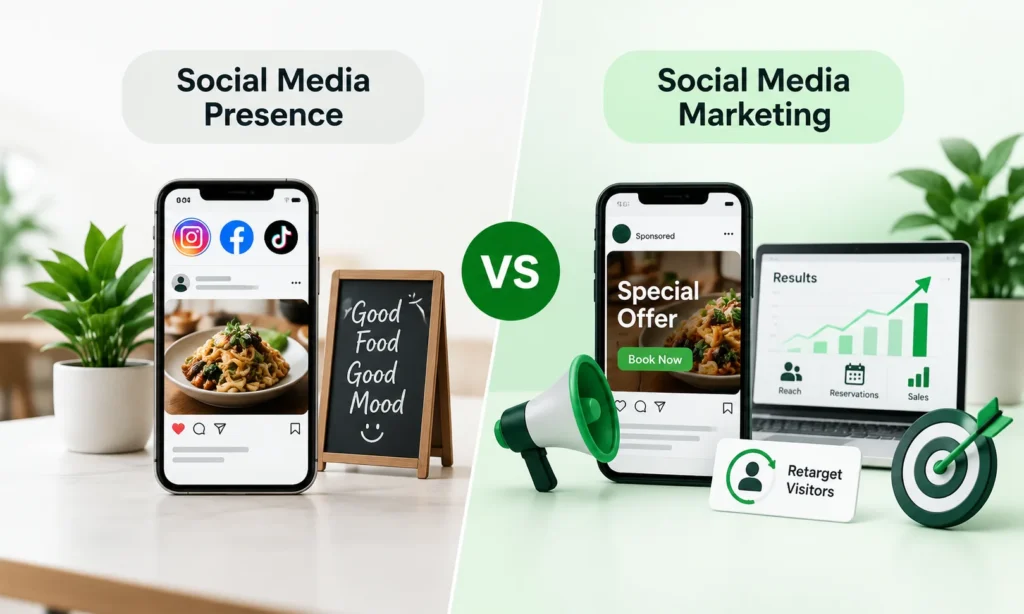
A social media presence means a business has active profiles and publishes content, while social media marketing uses those platforms strategically to achieve measurable business outcomes.
For example, a restaurant posting food photos three times per week has a social media presence.
A restaurant that publishes content, promotes local offers, retargets website visitors, tracks reservations, responds to reviews, and measures acquisition cost is using social media marketing.
The difference is strategy.
Presence asks:
“What should we post?”
Marketing asks:
“What business result are we trying to create, and how can social media help create it?”
Frequently Asked Questions
What Is Social Media Marketing in Simple Words?
Social media marketing means using platforms such as Facebook, Instagram, TikTok, LinkedIn, and YouTube to reach potential customers, build relationships, promote a business, and generate results such as leads and sales.
It combines content, engagement, advertising, and measurement rather than simply posting regularly.
What Is the Difference Between Social Media and Social Media Marketing?
Social media is the technology people use to communicate and share content, while social media marketing is the strategic use of those platforms by businesses to achieve specific marketing goals.
A person using Instagram to communicate with friends is using social media.
A company using Instagram to reach potential customers, promote products, and measure sales is doing social media marketing.
Is Social Media Marketing Only for Selling Products?
No. Social media marketing can be used for brand awareness, lead generation, customer education, recruitment, reputation management, customer service, community building, retention, and sales.
The purpose depends on the company’s business objectives.
Which Social Media Platform Is Best for a Business?
The best social media platform is the one where a business can efficiently reach its target customers using content that matches how those customers discover, evaluate, and buy products or services.
B2B companies may prioritize LinkedIn.
Visual consumer brands may benefit from Instagram, TikTok, Facebook, or YouTube.
The audience should determine the platform.
Do Small Businesses Need Paid Social Media Advertising?
Small businesses do not always need paid social media advertising immediately, but paid ads can help them achieve more predictable reach, leads, and sales once their offer and conversion process are ready.
Businesses should first understand their audience, messaging, offer, and customer journey.
Paid advertising should accelerate a good system rather than hide problems in a weak one.
How Do I Know If My Social Media Marketing Is Working?
Social media marketing is working when it produces measurable progress toward the original business goal, such as higher qualified leads, sales, conversion rates, revenue, reach, or lower customer acquisition costs.
Track the metrics closest to the intended outcome.
If the goal is sales, followers alone are not enough.
If the goal is awareness, immediate purchases may not be the primary measure.
Conclusion
Effective social media marketing begins with a clear business goal, not a random posting schedule. Once you know what you want to achieve, you can choose the right audience, platform, content, distribution method, and measurement system.
The goal is not simply to gain followers or publish more often. It is to attract relevant people, build trust, generate demand, and encourage meaningful action. Use this framework to guide your strategy: Business goal → Audience → Platform → Content → Distribution → Conversion → Measurement.
When these elements work together, social media becomes a measurable business asset that supports customer acquisition, brand growth, sales, and long-term retention.